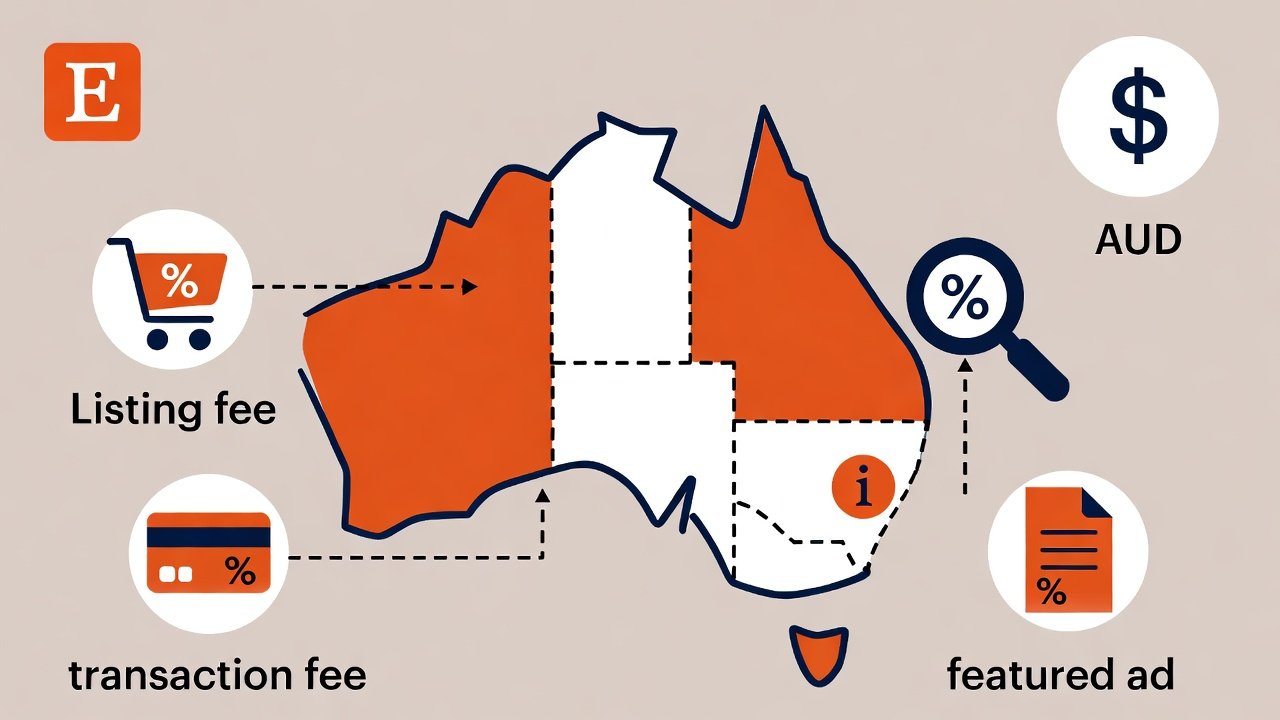
Etsy Fees for Australian Sellers: What You Need to Know
Selling on Etsy from Australia opens doors to buyers worldwide. But fees work a little differently here. Understanding the costs helps you price wisely and stay profitable.
This guide breaks down Etsy fees for Australian sellers. Simple words. Real numbers. No confusion. You can understand this.
Basic Etsy Fees That Apply to Everyone
These fees apply to all Etsy sellers. Your location in Australia does not change them.
Listing Fee: $0.20 USD Per Item
Etsy charges $0.20 USD to list each item. This fee is in US dollars, not Australian dollars.
Your bank converts the amount. The AUD cost changes with exchange rates. Check your statement for the exact amount.
Each listing lasts four months. If it sells and you have more stock, Etsy renews it for another $0.20.
Transaction Fee: 6.5% of Total Sale
When your item sells, Etsy takes 6.5% of the total order. This includes item price, shipping, and gift wrap.
Example: A $30 AUD sale with $10 AUD shipping equals $40 AUD total. The transaction fee is $40 × 6.5% = $2.60 AUD.
This fee is separate from payment processing. You pay both on every sale.
Payment Processing Fees for Australian Sellers
Etsy Payments is available in Australia. This simplifies fees and currency handling for local sellers.
Domestic and US Order Rates
For orders shipped within Australia or to the United States, the fee is 3% plus $0.25 AUD per order.
Example: A $35 AUD order to a US buyer. Payment processing fee: ($35 × 3%) + $0.25 = $1.30 AUD.
This rate applies to the total order amount. That includes shipping and gift wrap.
International Order Rates
For orders to other countries (like UK, Europe, or Asia), the fee is 4% plus $0.25 AUD per order.
Example: A $40 AUD order to the UK. Payment processing fee: ($40 × 4%) + $0.25 = $1.85 AUD.
Always check which rate applies. Your Etsy dashboard shows the correct fee for each order.
Regulatory Operating Fee for Australia
Etsy charges Australian sellers a Regulatory Operating Fee of about 0.32%. This small fee covers local compliance costs.
Example: A $50 AUD order. Regulatory fee: $50 × 0.32% = $0.16 AUD. Small but worth tracking.
This fee appears on your Etsy payment statement. It is separate from payment processing fees.
GST on Etsy Fees: What Australian Sellers Need to Know
Australia charges 10% GST on many business services. This includes Etsy fees.
Which Fees Include GST?
Etsy adds 10% GST to listing fees, transaction fees, payment processing fees, and ads.
Example: A $1.00 AUD transaction fee becomes $1.10 AUD with GST. The extra 10 cents goes to the Australian government.
If you are GST-registered, you may be able to claim this GST back. Keep good records. Your accountant can help.
Do Not Charge GST to International Buyers
US and other international buyers do not pay Australian GST on your items.
Only charge GST if you sell to Australian buyers and you are GST-registered. For most small sellers, Etsy handles this automatically.
When in doubt, check the ATO website or ask a tax professional. Rules can change.
Currency Conversion: AUD to USD
Most Etsy fees are charged in USD. You likely want AUD in your bank. Conversion happens somewhere. It costs money.
Who Converts the Currency?
Etsy or your payment processor converts USD fees to AUD. They add a small margin, usually 2.5%.
If you price in USD, US buyers see familiar prices. But you pay conversion fees when fees are charged.
If you price in AUD, international buyers may see converted prices. This can confuse some shoppers.
How to Reduce Conversion Loss
Option 1: Price in USD for international listings. Build a 3% buffer into your price for conversion costs.
Option 2: Use Etsy's multi-currency feature. Buyers see prices in their currency. You receive AUD. Etsy handles conversion.
Option 3: Track exchange rates weekly. Adjust prices if the AUD strengthens or weakens by more than 3%.
Shipping from Australia: Costs and Tips
Shipping from Australia can cost more due to distance. Plan for this to stay profitable.
Australia Post: Reliable and Tracked
Australia Post offers international shipping with tracking. Small packets to the US cost $15-30 AUD.
Delivery takes 10-21 business days. Tracking is included with most services. Buyers appreciate updates.
Best for: Low to mid-price items, buyers who understand longer shipping times.
Private Couriers: Faster but Pricier
DHL, FedEx, and UPS ship from Australia to the US in 3-7 days. Costs start around $40-80 AUD for small packages.
Tracking is reliable. Customs clearance is smoother. Buyers love fast delivery.
Best for: High-value items, custom orders, or shops targeting premium international buyers.
Free Shipping Strategies
Buyers love free shipping. Offer it on orders over $50 AUD. This encourages larger orders.
Build shipping costs into your item price. Then mark it as free shipping in Etsy settings.
Free shipping also boosts your search ranking on Etsy. It is a win-win for visibility and sales.
Calculating Your True Profit: Australian Example
Use this formula to find your real profit. Do not skip any step.
Step-by-Step Cost Example
Item: Handmade boomerang keychain. Sale price: $22 AUD. Shipping charged to buyer: $15 AUD. Total order: $37 AUD.
Materials: $6 AUD. Packaging: $2 AUD. Shipping cost (Australia Post): $12 AUD.
Etsy listing fee: $0.20 USD ≈ $0.30 AUD. Transaction fee (6.5% of $37): $2.41 AUD.
Payment processing (3% + $0.25 for US order): $1.36 AUD. Regulatory fee (0.32%): $0.12 AUD.
GST on fees (10% of $4.19 in fees): $0.42 AUD. Currency conversion loss (estimated 2.5%): $0.93 AUD.
Total costs: $25.54 AUD. True profit: $37 - $25.54 = $11.46 AUD. Margin: 31%.
This example shows why counting every fee matters. Missing one cost can turn profit into loss.
Tips to Stay Profitable as an Australian Seller
Australian sellers face extra costs. Smart planning protects your profit.
Price in USD for Global Reach
International buyers expect USD prices. Pricing in USD removes friction. They know the cost upfront.
Calculate your costs in AUD. Convert to USD. Add fees and profit. Round to a clean number like $24.99 USD.
Update prices if exchange rates shift more than 3%. Small adjustments protect your margin.
Bundle Items to Spread Shipping Costs
Shipping one item costs $15 AUD. Shipping three items together may cost $22 AUD. You save $8 AUD.
Offer bundles: "Buy 2, get free shipping" or "Gift set: 3 items for $55 AUD."
Bundles increase your average order value. They also make shipping more efficient.
Track Fees in Both AUD and USD
Etsy shows fees in USD. Your bank shows deposits in AUD. The difference can confuse your profit math.
Keep a simple spreadsheet. Record each sale in both currencies. Note the exchange rate used.
This habit keeps your numbers accurate and tax-ready.
Claim GST Credits If Registered
If you are GST-registered, you can claim back the GST you pay on Etsy fees.
Keep separate records for GST on fees. Your accountant or BAS statement can help you claim it.
Small savings add up. Do not leave money on the table.
Common Mistakes Australian Sellers Make
Learn from others and avoid these costly errors.
Mistake 1: Forgetting Currency Conversion Fees
Many sellers count Etsy fees but forget the hidden conversion cost. This can erase 2-3% of profit.
Always add a conversion buffer to your price. Even 2-3% protects your margin.
Mistake 2: Underestimating Shipping Time
Shipping from Australia can take 15-21 days. International buyers used to fast delivery may get impatient.
State shipping times clearly: "Ships from Australia. Delivery: 10-21 business days."
Offer courier upgrades for buyers who need items faster. Charge extra for the service.
Mistake 3: Ignoring GST on Fees
If you are GST-registered but do not track GST on fees, you miss out on credits.
Keep clear records. Separate GST amounts on your fee statements. Claim them on your BAS.
Small oversights add up. Good records protect your profit.
Mistake 4: Pricing Only for Local Buyers
Pricing only in AUD limits your global reach. International buyers may skip your listing if they cannot understand the cost.
Use Etsy's multi-currency feature. Or price key listings in USD for international appeal.
Think global. Price smart. Sell more.
When to Review Your Pricing Strategy
Markets change. Fees change. Exchange rates change. Stay flexible.
Review Quarterly
Every three months, check your fees, shipping costs, and exchange rates.
Adjust prices if costs rise by more than 5%. Small, regular updates prevent big profit surprises.
Use Etsy's Stats to see which listings earn the most. Do more of what works.
Test Small Changes
Raise prices on five items by $2-3 AUD. Watch sales for two weeks.
If sales stay steady, keep the new price. Most buyers do not notice small changes.
Test one thing at a time. Learn what works for your shop.
Final Checklist: Australian Seller Fee Ready
Before you list or adjust prices, confirm these points:
- I calculated all fees: listing, transaction, payment processing, regulatory, GST, and conversion
- I priced with a buffer for exchange rate changes
- I set accurate shipping profiles for domestic and international orders
- I mentioned shipping times and customs clearly in my descriptions
- I track sales and fees in both AUD and USD
- I review costs and adjust prices every 3 months
If you checked most boxes, you are ready to sell from Australia with confidence.
Final Thoughts on Etsy Fees in Australia
Selling from Australia has extra steps. But global buyers value unique Australian crafts. The opportunity is real.
Start simple. Track one sale fully. Learn the process. Expand as you get comfortable.
Remember: Every successful Australian seller started where you are now. They learned, adjusted, and grew.
Keep creating. Keep calculating. And keep sharing your unique craft with the world.
You do not need perfect systems. You need a system you will actually use.
Pro Tip: Save your fee calculation formula in a note. Reuse it for new items. Consistency saves time and protects your profit.
Important Note: Fees and tax rules change. Always check Etsy's official help pages and the ATO website for the latest information. When in doubt, consult a qualified accountant.