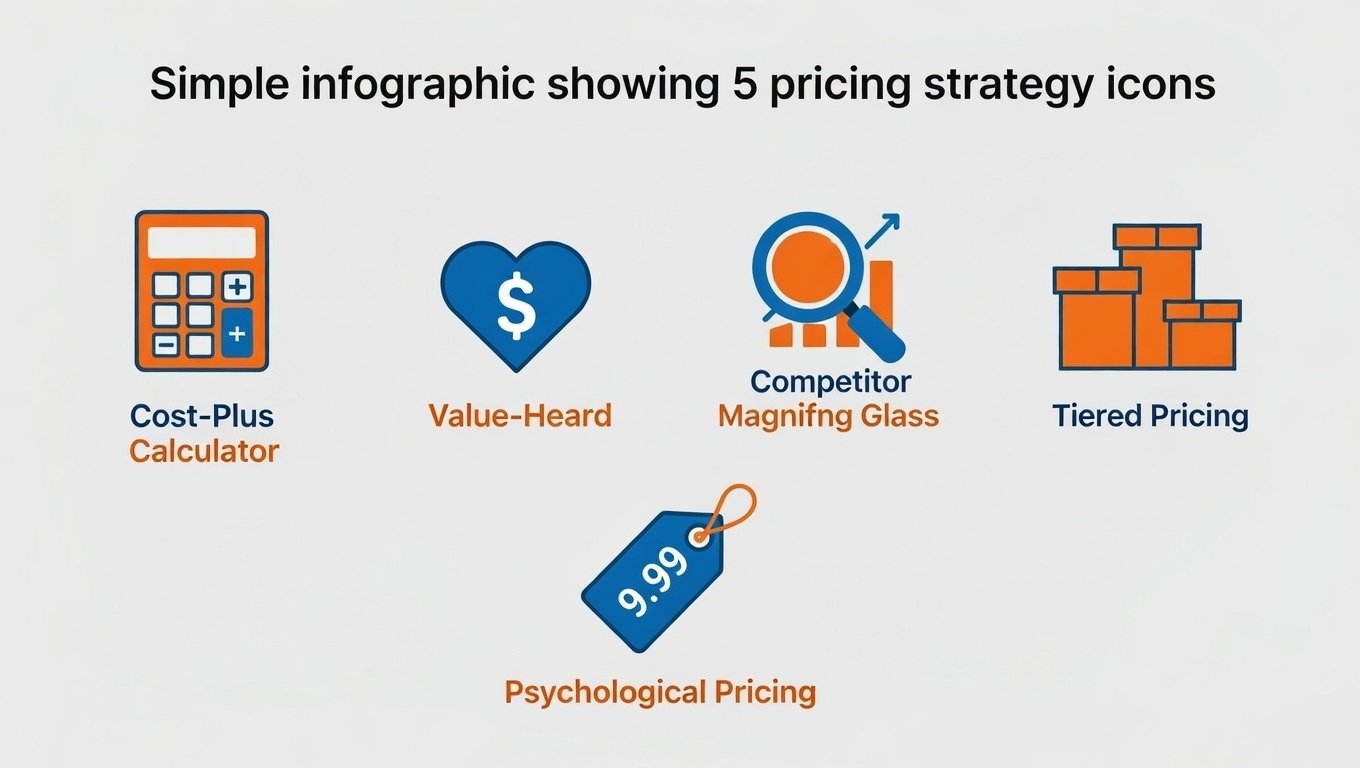
Top 5 Pricing Strategies for Etsy Sellers
Pricing your items feels tricky. Charge too much, and buyers scroll past. Charge too little, and you lose money. The right strategy helps you win.
These five proven strategies work for Etsy sellers in 2026. They use simple math and real-world thinking. No confusing theory. Just practical steps you can use today.
Strategy 1: Cost-Plus Pricing (The Safe Start)
Cost-plus pricing means you add up all your costs. Then you add your profit. Simple and safe for new sellers.
Step 1: List every cost. Materials, packaging, Etsy fees, shipping supplies, and your time. Write down real numbers, not guesses.
Step 2: Add your profit goal. Many sellers aim for 20-30% profit. This rewards your skill and effort.
Step 3: Add it all up. That number is your minimum price. You can go higher, but never lower.
Real Example: Handmade Soap Bar
Materials: $2.50. Packaging: $0.75. Etsy fees (estimated): $1.80. Your time (15 min at $15/hour): $3.75.
Total costs: $8.80. Add 30% profit ($2.64). Final price: $11.44. Round to $11.99 for a clean look.
This method guarantees you never sell at a loss. It builds confidence as you learn the business.
Strategy 2: Competitor-Based Pricing (The Market Check)
Look at similar items on Etsy. See what they charge. Price your item in the same range.
Do not copy prices exactly. Instead, find the middle ground. If most sell for $18-25, price at $21.99.
Adjust for your unique value. Better photos, faster shipping, or personalization can justify a higher price.
How to Research Competitors
Search your item on Etsy. Filter by "Best Selling" to see what works.
Check 10-15 similar listings. Note their prices, reviews, and photos. Look for patterns.
Ask: Why do buyers choose the expensive ones? What do the cheap ones lack? Use these clues to position your item.
Remember: You are not racing to the bottom. Quality buyers pay for quality items.
Strategy 3: Value-Based Pricing (The Premium Play)
Value-based pricing means you charge what buyers think your item is worth. Not just what it costs to make.
This works best for unique, emotional, or custom items. A personalized wedding gift can cost more than a basic version.
Focus on the benefit, not the product. You are not selling a candle. You are selling relaxation, ambiance, or a thoughtful gift.
How to Find Your Item's Value
Ask past buyers why they purchased. Read your reviews. Look for emotional words like "perfect gift" or "so special."
Use these words in your listing. When buyers feel the value, they accept higher prices.
Test small price increases. Raise your price by $2-3. Watch if sales drop. If they stay steady, you found room to grow.
Strategy 4: Tiered Pricing (The Choice Builder)
Tiered pricing offers the same item at different price points. This gives buyers options and increases your average order value.
Example: A necklace listing could have three tiers. Basic chain: $28. Sterling silver upgrade: $38. Gift box + card: $45.
Most buyers pick the middle option. This is called the "decoy effect." It feels safe and valuable.
How to Build Tiers That Sell
Start with a solid base option. Price it fairly using cost-plus or competitor research.
Add one or two upgrades. Make them desirable but not essential. Good options: faster shipping, gift wrapping, personalization, or premium materials.
Clearly show what each tier includes. Use bullet points or a simple table. Confused buyers do not buy.
Tiered pricing works great for customizable items. It also reduces decision fatigue for shoppers.
Strategy 5: Psychological Pricing (The Mind Trick)
Psychological pricing uses small tricks to make prices feel better. Buyers respond to these cues without realizing it.
The most famous trick: ending prices in .99. $19.99 feels cheaper than $20.00, even though the difference is one cent.
Other tricks: Use $27 instead of $25 for premium items. Odd numbers feel more calculated and fair. Round numbers feel luxurious.
Simple Psychology Tips for Etsy
End most prices in .95 or .99. This works well for items under $50.
Use round numbers ($50, $100) for luxury or gift items. This signals quality and simplicity.
Show savings clearly. "Was $35, now $28" creates urgency. But only use this for real sales, not fake discounts.
Bundle items and show the per-item savings. "Set of 3 for $25 (save $5)" encourages larger orders.
How to Choose the Right Strategy for Your Shop
Not every strategy fits every seller. Match the method to your goals and experience level.
Use Cost-Plus If:
You are new to selling. You want to avoid losing money. You sell simple, low-cost items.
Use Competitor-Based If:
You sell popular items with many similar listings. You want to stay visible in search results.
Use Value-Based If:
Your items are unique, custom, or emotional. You have great reviews and repeat customers.
Use Tiered Pricing If:
You offer customization or variations. You want to increase your average order value.
Use Psychological Pricing If:
You want to test small improvements. You sell items under $100 where cents matter to buyers.
Combine Strategies for Best Results
You do not have to pick just one. Smart sellers mix methods.
Example: Start with cost-plus to find your minimum. Check competitors to see the market range. Add psychological pricing for the final number.
Another example: Use tiered pricing for your main listings. Apply value-based thinking to your premium tier.
Test one change at a time. Raise prices on five items. Watch sales for two weeks. Adjust based on real results.
Common Pricing Mistakes to Avoid
Even experienced sellers slip up. Watch for these traps:
Mistake 1: Forgetting Your Time
Your skill has value. If you spend one hour making an item, pay yourself at least minimum wage for that time.
Include this cost in your price. Otherwise, you work for free without realizing it.
Mistake 2: Underpricing to "Get Sales"
Low prices do not always mean more sales. Buyers sometimes think cheap means low quality.
Price fairly for your value. Attract buyers who appreciate your work, not just bargain hunters.
Mistake 3: Never Raising Prices
Costs go up over time. Materials, fees, and shipping get more expensive.
Review your prices every 6 months. Small increases keep your profit healthy without shocking customers.
Mistake 4: Copying Prices Exactly
Every shop has different costs. Your materials, time, and fees may differ from a competitor.
Use competitor research as a guide, not a rule. Price for your business, not theirs.
Quick Pricing Checklist
Before you publish a price, ask these questions:
- Did I include all costs: materials, fees, packaging, and my time?
- Did I add a profit margin (at least 20%)?
- Is my price in line with similar items on Etsy?
- Does my listing clearly show the value buyers get?
- Did I use a clean, psychological price ending (.95 or .99)?
- Have I tested this price on a few items first?
If you answer yes to most, you are ready to list with confidence.
Final Thoughts on Pricing
Pricing is not a one-time task. It is a skill you improve over time. Start simple. Learn from your sales data. Adjust as you grow.
Remember: Your price tells a story. It signals quality, care, and value. Price with intention, not fear.
Track your results. Note which prices sell best. Use that knowledge for future listings.
You deserve to make a fair profit. Charge what your work is worth. Keep creating, keep learning, and keep growing your shop.
Pro Tip: Save your pricing formula in a note or spreadsheet. Reuse it for new items. Consistency saves time and reduces stress.